 |
|
| Totally Non-official website of Emese and Pavel | |
 |
|
Post details: Peter: Born Before ArrivalPeter: Born Before Arrival 2011-05-23
It promised to be a morning like any other over the past week or so: I would be desperately catching up with writing my PhD on the advance of neoliberalism, while my very pregnant partner Emese would be struggling to start delivering our son Peter. Peter was 12 days overdue. Well within her maternity leave Emese had been trying all that is humanely possible to get him to come out, including gymnastics, long walks, sex, intensive gardening and a few other methods. But to no avail, and no substantial contractions. Undisturbed, Peter would hang on to his apparently convenient embryonic position, forcing his mother to despair and schedule an induced delivery for the coming Sunday. The first time it occurred to me that Friday would be different was when Emese asked me to put up the baby cot in the room. She had just taken our daughter Maia to school. Emese was then quick to play down any expectation that the baby might be coming soon, making her usual long face of bored denial. She then shook her palms in the air in a familiar gesture that I had long ago learned to interpret as the equivalent of “all quiet on the Western Front.” In this case it sounded to me more like: no, no birth today; some more frequent contractions maybe; but nothing urgent anyway. We had a joke going that of all days Emese should avoid giving birth on Friday. This was because it happened to be May 20 – the birthday of both her father, and my late artist uncle. Half-jokingly I had been warning her that if born on May 20 our son would have to be named after both of them. She had been responding half jokingly that she would rather hold the baby for a day. Easier said than done. It was May 20 and she seemed to be going into labour. One thing was clear: I was not about to progress further with my thesis writing on that day. Instead I busied myself with tidying up the bedroom where the new-born’s cot finally appeared. Then ironed my shirt. If we celebrate each other’s birthdays every year it should make sense to dress up for the real thing, I thought. My son Ivan saw me and grew immediately suspicious: where was daddy going? “To the hospital with your mum,” I replied But Emese was not sure about that yet. In the meantime she did some of her usual house keeping, but also prepared her little travel suitcase and asked me to take it down to the car. With midday approaching my anxiety grew. Emese kept acting relaxed. Thinking back about these hours I believe it was a combination of factors that made her postpone the decision to leave until the last moment. She probably could not easily believe that the ‘thing’ was finally happening after so many days of futile expectation. There was also her all too familiar Huppert feature that obliges her to act cool as if nothing special is happening. And there was the NHS.
With both of our older children having been born in Budapest we had been eagerly investigating English health care, particularly with regard to pregnancies and birth. Media reports and friends’ personal accounts had drawn a rather bleak picture of a system driven ultimately by minimizing costs. We knew, for example, that unlike Hungary, here women would not normally be allowed in hospital until actual labour begins, and would be sent home as soon as possible with the new born. Doctors would only tend to complicated deliveries, and many women would actually give birth at home, assisted by a midwife. Equipped with the confidence of a veteran mother of two, and based on her first-hand observations of the UK medical system as a clinical research associate, Emese was quite relaxed about all this. Home delivery was out of question of course, but she had signed up with a special department at the John Radcliffe Hospital – the Oxford Spires Midwifery-led Unit. According to its website, the unit offers women “an alternative to the consultant-led maternity service,” different facilities, as well as a breath-taking view from the seventh floor of the hospital. But Emese was not get to the top floor that day. She had repeatedly been told that she should not bother arriving too early, not until established labour began, otherwise she would be sent off. This was what they told her again when she called them about 11 am on that Friday: are you really sure it has started, dear? Well, she wasn’t. Not after expecting the bloody contractions to begin for about two weeks. Now that they were happening, she did not dare thinking labour was soon to come. So instead of heading to the hospital, we took our lunch and I did some emailing. Emese took a bath. Now, taking a bath was probably a good idea in terms of getting herself relaxed and confident. But as we learned later, it must have also worked as a tranquiliser, suppressing the otherwise increasing unease from the contractions. The fact is that when she came downstairs all dressed up and ready to go her contractions all of a sudden seemed quite powerful and painful. And frequent. It was about 1 pm. I watched her make another phone call in-between two of them. Again, she sounded very calm and polite, as she usually does. I did not hear what the midwife on the other end of the line said, but Emese told her: “All right then, but I think I am coming anyway, I would like to… be checked.” Innocent as this sounded, I was aware that this is the upmost urgency that Emese was capable off. A contraction later we were out of the house and into the car, I felt anxious but confident, and so did Emese. She asked me the time when we were driving off, and I said it was 1.10 pm.
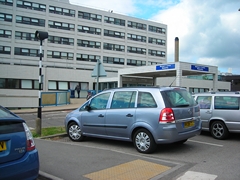
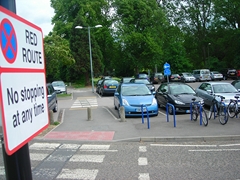
From this moment on my memory plays a naughty trick on me. Basically I remember things with clarity and detail much sharper per minute, somewhat like a slowed-down video effect. During all this time Emese had been complaining more and more, while giving me driving directions – which I must admit were quite helpful, as I had never driven to the hospital before. Once we were there I asked her whether I should stop in the in front of the hospital’s doors, but she instructed me to park. So I did. It took me about a second to decide to take the first empty slot that I saw rather than drive around and seek for parking place nearer the hospital entrance. We were out from the car. I placed the parking card in my back pocket, grabbed Emese’s handbag and my jacket, waited on a contraction to pass, and began walking slowly towards the hospital’s doors. “Close my bag,” she commanded. I obeyed. “Will you be able to walk there?” I asked, pointing at the gate. “Let’s go,” said Emese. We made it to the end of the parking lot, and were just about to cross the street, when she stopped. “Oh, Pavel, I think we are a bit too late this time.” I have no memory of replying. I was just standing there, with Emese leaning on me, looking helplessly at the hospital’s entrance, still about 20 meters away. The next thing I heard from her was more of a cry: “My waters just broke.” I looked down and saw her trousers were all wet indeed. A person was walking on the other side of the street. I shouted: “Sorry, could you please call someone, we are giving birth here.” The man stopped looking at me unbelievingly. “She is giving birth, please call someone,” I shouted again. He turned to the door, walking faster. Not fast enough I thought. Peter’s birth Have you had nightmares where something horrible is happening, and you need to run fast, but all of a sudden you cannot move your legs, they feel heavy, and glued in the place, and the more you try to run, the more impossible it is to even move a step, and then you wake up? In this very moment, on the sidewalk in front of the gates of the JR hospital’s maternity unit I remembered that I had had many. And I felt like I was in one again. Except there was no waking up from this one. Emese was still leaning on me. “I am giving birth now” she announced, while pulling down her trousers and reaching to kneel on the sidewalk. We may even have had a little exchange on whether she should not be lying down on her back. “No, no, the baby is already out,” she said, still holding my hands, “just call someone.” I shouted for help again. I could see someone running towards us. Very very slow, it seemed. Others were coming after, with a push-chair. I heard voices around, giving directions to Emese, holding her, encouraging her, but do not remember what they were saying. All of a sudden I was overwhelmed by anger. “You might have kept us waiting at home longer,” I head myself growling. I must have looked quite pitiful because a woman turned to me and asked: “Are you all right?” I wasn’t. I felt like bursting in tears myself, but was still too angry to do that. The hospital papers folder fell from my hands. A man in a medical uniform was behind Emese. “We have a little baby here” he exclaimed and reached down. The next thing I saw was Peter. Tiny and wet, covered with wrinkles and stains of blood, there he was, motionless in the hands of the guy. “Don’t worry, baby’s breathing,” he said cheerfully. A small whole opened on Peter’s face and I heard his first cry. “Take care.” “Congratulations.” “Oh, bless,” female voices spoke around. Emese was almost on the pushchair. “Careful with that cord,” the man said again, reached with his hands and untangled Peter from the loop of the belly-cord. They then placed the baby on top of Emese, covered him with my jacket, and started moving. I collected some papers from the ground, and hurried after them for probably the most emotional walk in my life.
With Emese sitting on the chair, holding Peter in her arms, and gently talking to him in Hungarian, we moved through the sliding doors, along a few dark corridors, and into a delivery room. Finally Emese was able to lie down, helped by about five people who had come along. The man in the hospital apron was still among them, but left as soon as he saw that things were under control, wishing us best luck. I then learned he worked at the scanning unit, saw us through the window, and immediately ran out to help. His name was Paul. Thank you, Paul! A tall woman with what seemed like a long fair hair appeared to be in charge and everyone left promptly. She calmed us down, congratulated us, asked if it was our first baby. Well, it was the first one born outdoors for sure. What is the time of birth, she asked? Three minutes ago, just here, in front of the hospital, I explained. We all looked at the big white clock on the wall. It was 1.25 pm. The fifteen minutes since we had left home felt like a decade.
Sarah was very friendly and helpful, explaining carefully what was going on, and what was supposed to go on. In a few minutes she came in with a set of shiny instruments, handed me the tiniest one, and asked me to cut Peter’s cord. I did. The ritual was not as emotional as I expected it, possibly in contrast with what I had just been through. But I enjoyed it nonetheless. Later, Sarah suggested that Emese would try to breastfeed in order to speed up the afterbirth – if she was planning on breastfeeding the baby, of course. Once the placenta was out, Sarah said she would need to examine for wounds, and asked Emese if she would like an anaesthetic for the examination. Emese refused. The examination took about 3 minutes. Others would have cried loud by now, Sarah told Emese: “you seem to be made of the stern stuff.” I bet she is.
We were then left alone for a while, relaxing and getting to grips with what had just happened. Emese’s clothes and my jacket were all wet and bloody, stuffed in a large plastic bag. I was sent off to bring Emese new clothes. I walked out from the room into a corridor, realizing I had no idea where and how I had come from. Following the Exit signs I made my way to the main lobby and walked out into the sunshine, to the place where Peter was born. Déjà vu - Born Before Arrival There I stood, watching the sidewalk tiles, where some dried stains could still be seen, the parked cars around, the zebra crossing and the number 10 bus which just drove past. They all seemed strangely dear. This is all about emotion, place and space, I thought, and my colleagues at the Open University should surely be able to explain it. Humour aside, I felt that what happened on Friday had a lot to do with the topic of my Geography PhD. After taking a few pictures of this unlikeliest of birthplaces, I slowly drove home. The parking barrier had just closed behind me, and this time the 20 m/h speed limit seemed perfectly reasonable. At this moment something caught my eye. A woman was lying on the sidewalk, just a few meters down the road from the Maternity unit. Other people were helping her up. I could not see clearly from the car, but the thought immediately crossed my brain that she was probably also having contractions on the street. Apparently my mind had not cleared up well because I needed to drive twice back and forth from the hospital to deliver the bag of clothes to Emese. While doing this I managed to bring the news of Peter’s birth to his sister and brother at home, and to my parents using the internet. But when I was back in the hospital room, I asked Sarah about the second woman whom I had seen falling down on the sidewalk. “Yes, it has been one of those days today,” she exclaimed, offering no further explanations. Later we heard from her that deliveries on the way to the hospital are not at all uncommon. This is why many mothers prefer home birth, she concluded. BBA, born before arrival, is the abbreviation for these cases which appears in Peter’s medical notes as well.
Many things can be said about this extraordinary child birth experience. Starting from the unforeseen perils of having a due date that may be unrealistically early. Indeed, of all three babies we have had so far with Emese, Peter is the tiniest, his weight at birth being about 3.250 kg. Reaching and passing the due date puts psychological pressure on the mother-to-be who expects her labour to start any moment. With Emese this expectation lasted for 12 days and was gradually replaced by disbelief, which influenced her judgments when the time finally came. I am the family member mostly known to have been missing airplanes and – admittedly for the purpose of analysis – a couple of work deadlines. Emese in contrast has been more realistic in her planning and preparations. Knowing that both of her previous deliveries had been quite fast is one thing, but giving birth within about 15 minutes from her first strong contraction is something few people could adequately prepare for. The only way to handle such a marginally quick delivery would be to be admitted into hospital at the first signs of labour. And we were simply in the wrong country for this. Or at least in the wrong social class. Apparently our post-socialist life experiences so far with Emese had not adequately prepared us for the way things work here, in one of the world’s wealthiest and most advanced societies. With all of its drawbacks, Hungary’s health system would keep the hospital’s gates open for anyone suspected to be going in child labour. Emese’s first birth – of our daughter Maia back in 2006 – was also overdue. After a week had passed, though, the hospital would request Emese to report to them every morning, for thorough control of the pregnancy. An induced delivery would be prescribed and performed within days. There is mounting criticism of the standard child birth practices both in Hungary and Bulgaria, where I come from. They are condemned for their high proportion of planned c-sections, over-medicating mothers, and inflexibilities on alternative delivery methods. Home birth is not practiced officially in any of the two countries, something which was labelled as no less than an assault on the “right to birth at home”, as The Guardian reported in October 2010. But what about the right to proper medical care? I think both Emese and I were unprepared for the grasp of the cost cutting and optimisation imperative has over the work of health care professionals in the UK. If obliging pregnant women to report to the hospital for an induced birth shortly after their first overdue week is wrong, so is actively discouraging them from coming to the hospital when they suspect they are already in labour. Based on the anecdotal evidence we received from various persons while at the hospital, the BBA syndrome is quite common. The way I see it, UK women are subject to pressure to arrive in hospital as late as possible, and leave as soon as they can. Or, rather, this is the case with women who rely on the NHS for delivering their children. I have no idea how things work in the private clinics. And this is where I disagree with the coalition government’s cost-cutting ideology: access to quality and reliable health care should be available to anyone, poor or rich, and not be compromised by a neoliberal cost-cutting imperative.
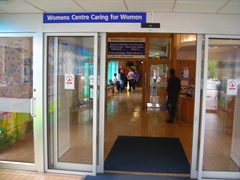
Photos, from top: 1. Peter - a blurred first portrait. 2. A view of the John Ratcliffe Hospital's maternity unit from as near as we could get to it before Peter was born. 3. A birth spot to remember. 4. The way into the hospital - three of us entered. 5. Peter's hair and chin. 6. Emese and Peter, happy and relaxed. 7. Tea and toast served. 8. Maia and Ivan welcoming Peter. 9. Three of us on the way home after delivery. Comments:
Comment from:
Nathan Johnson [Visitor]
Hi Pavel (& Emese).
This is a beautifully written piece of an incredible series of events. Congratulations on the successful, if unconventional, birth. Peter looks like a little sweetie. Best to you all.  2011-05-23 @ 17:04
Comment from:
Miklos Toth [Visitor]
Hi Emese, Pavel, Maia, Ivan & Peter!
Incredible story, i can't imagine how was it, realising you won't make to the hospital and have to give birth just a few meters from it. Congratulation for the healthy baby again! Best wishes
2011-05-23 @ 17:49
Comment from:
Sylvia Magyar [Visitor]
Wow, what an incredible story and also beautifully narrated. Congratulations to you all!
Sylvia
2011-05-23 @ 22:38
Comment from:
Ben [Visitor]
Dear All,
Your incredible story is OK because it is ending well with the joy of celebrating the arrival of Peter ....but what a sign of the appaling state of the UK medical system! We are not able to meet Peter as quickly as Maia and Ivan and we can't wait to see the 5 of you soon Take care and enjoy! Erzsebet & Ben PS: Emese you are simply amazing!
2011-05-24 @ 18:44
Comment from:
Dafne [Visitor]
What a story, Pavel! Both of you are very brave, no doubt!! Congratulations and all the best for you and your lovely family!
2011-05-24 @ 20:34
|
|
 Supposedly long overdue, my son managed to take his first breath on the sidewalk in front of the hospital. In a cadenced retrospective I am checking for fault play by the budget-squeezed NHS, to conclude that all is well, as long as it ended well.
 The Oxford Spires Midwifery-led Uni
 Ten minutes that shook our world
 A walk of life
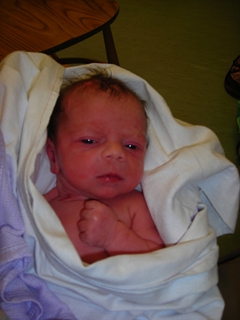 It was a beautiful face. Peter had relatively long dark hair. His eyes seemed small but shiny, and somewhat curious and witty. Indeed, unlike any of our previous two children, Peter stopped crying almost immediately and started looking around the newly discovered world that surrounded him. In spite of being supposedly 12 days overdue, he seemed tinier than both Maia and Ivan when they were born. But at the same time he was somehow better developed, his feature more distinct, his character – more visible. A possible reason for this impression was his contoured chin – a feature that I immediately attributed to the Huppert family genes, while Emese said it looks like mine.
 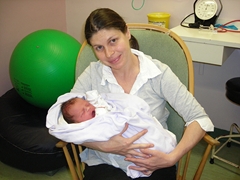 Soon the final medical procedures were completed. The second midwife congratulated us, and just before leaving the room, turned to me and suggested very casually that perhaps we were thinking of going home already tonight, but of course this was entirely up to us, so whatever we decided. I responded that this should depend on Emese’s condition, but she repeated that the decision was up to us, and no pressure whatsoever… It was clear what the decision should be. And honestly in this case both Emese and I were really looking forward to get home as soon as possible.
 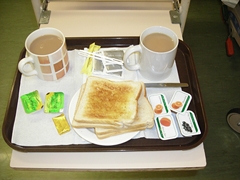 Upon my return to the room tea had been served. A lovely surprise. We spent another three hours together, Emese, Peter and I. Sarah came again at some point and handed us a stack of papers. She then explained what were they; and how we were supposed to be visited by the midwife on the following day; and that we had to take Peter for an initial medical assessment first thing on Monday; and that all I had to do was register for the birth certificate online and it would be mailed to us shortly. After all was clear, she said: “So, I get it, you would want to be heading home tonight already, so buzz me when you want to leave. “We shall go now,” Emese replied. After the final round of congratulations, just as we were walking out, Sarah said: “And perhaps you should consider a home birth the next time around.” There will be no next time, Emese replied.
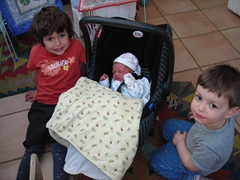 It was 7.30 pm when we walked home with Peter. Maia and Ivan were thrilled to meet him. We took photos, then a quick dinner. We were exhausted. I placed Peter on his bed. Then moved downstairs to the new location of my working desk, and posted the first announcement of his birth on Facebook. Emese went straight to bed for her first sleepless night over the new born Peter.
 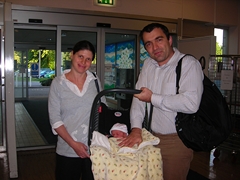 But as Emese rightly pointed out, this is supposed to be the story of my son’s birth, and not a political pamphlet. She also said, that even after everything that has happened, she still likes the English system of doing things better than the Hungarian one. And it is the mother’s opinion that matters most when giving birth is at stake, isn’t it? Two things for sure: this was probably the fastest and least painful delivery Emese could have had; and we all feel happy and relieved about it.

 След 12 дневно закъснение, третият ни отрок предпочете да се роди на чист въздух. Не можем да го виним за това, разбира се.
 Изненадващо дългоочаквано пристигане: имаме и син
 Времето,болката, слънцето, или как се роди едно дете
 A first-hand account by her first-time father